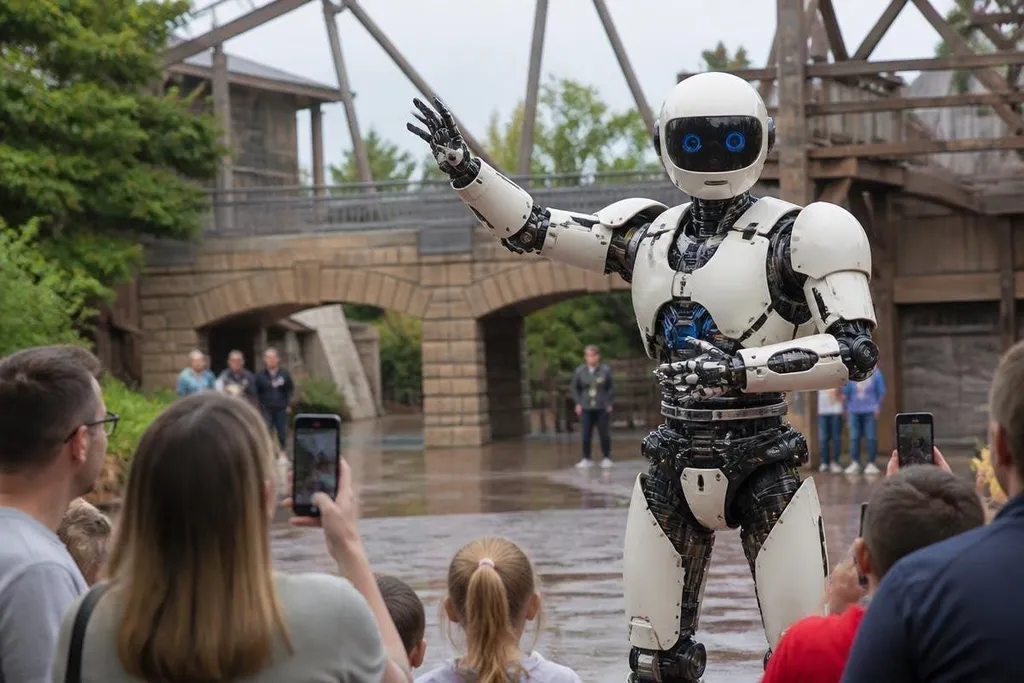
A theme park robot has to repeat the same show while dealing with changing light, sound, weather, and guests. That demand is pushing park machines beyond fixed motion loops toward systems that sense their surroundings and adjust what they do.
- Sensors can track position, movement, and nearby objects.
- Software can change timing without rewriting every motion.
- Human operators still handle safety, maintenance, and unusual cases.
Fixed movement has a hard limit
Older animatronic systems can run a carefully timed sequence for hours. Motors move joints, audio starts at set points, and control software sends the same commands each time.
That method works when the setting stays controlled. It becomes harder when a guest blocks part of a stage, a prop shifts position, or a show has to pause and restart from a safe point.
Newer systems can add cameras, distance sensors, position feedback, and force sensing. These tools let the robot check what is happening instead of relying only on the clock.
The change matters because timing alone cannot tell a robot whether a moving arm has found the right position. Feedback can do that by comparing the planned motion with the measured position, then slowing or stopping the joint when the two differ.
What more capable software changes
A theme park robot still follows rules written by engineers. The difference is that those rules can include more possible responses.
A system may run one motion when the stage is clear, another when an object sits inside a safety zone, and a third when the show pauses. The robot is not making open-ended decisions. It is selecting from approved actions based on sensor input.
That approach can also help with repeated performances. If a joint reaches its position a little early, control software can adjust the next movement. If the robot detects an unexpected load, it can stop the motion and alert an operator.
The same idea applies to mobile robots. A machine moving through a park needs a map, location data, obstacle detection, and a way to stop when its route is blocked. A robot that works only on an empty test path will need more work before guests can share that space.
A public show adds guests, staff, noise, and tight timing to the test. Robot24 can help you compare a park robot’s route, stop rules, test date, and human support with what its maker says it can do.
Why parks are using robots in public shows
Park robots can repeat a physical performance with the same timing across many show cycles. That consistency may help when a character, creature, or moving prop has to match lighting, sound, doors, screens, or other stage equipment.
They can also perform motions that would be tiring, risky, or hard to repeat by hand. The benefit depends on the task. A machine that carries out one controlled sequence has a different job from a mobile robot that shares a walkway with visitors.
The public setting adds another layer. A park must account for clothing, bags, children, weather, noise, camera flashes, and people standing outside the expected viewing area.
These conditions test the sensing and safety systems more than a closed workshop does. The robot’s appearance matters too, but appearance cannot hide poor recovery behavior.
If a machine freezes, repeats a motion, or needs an operator after a small change, guests see the limit at once.
The limits are still visible
More sensors and software add more parts that can fail. Cameras can lose a clear view, position sensors can drift, and control software can stop a show when it detects a condition that a human considers harmless.
Maintenance also shapes the result. Park robots run in public, often on tight schedules, so technicians need access to motors, cables, covers, and emergency stops. A design that looks good from the audience area can still be difficult to repair.
The largest open question is how well these systems handle rare events. A planned routine may work for thousands of cycles, while an unusual obstruction reveals a gap in the safety plan.
I’d judge a theme park robot by its recovery after an unexpected stop, not by its smoothest performance.
A practical check before calling a robot advanced
Use these questions when you assess a new park robot or public demonstration:
- Sensing: What does the robot measure, and where are the blind spots?
- Safe stop: Can it stop quickly when a person or object enters its path?
- Recovery: Can it resume from a known safe position after a pause?
- Service: Can technicians reach the parts that need regular checks?
- Evidence: Does the demonstration show a full run, including a fault or restart?
A robot that reacts to its surroundings is a step beyond a fixed routine, but the useful measure is still practical: how safely it repeats the show, handles a change, and returns to work after something goes wrong.